The use of artificial intelligence (AI) in a defence context poses significant ethical questions and risks. Defence will need to address these as AI systems are developed and deployed in order to maintain the reputation of the ADF, uphold Australia's domestic and international legal obligations, and support the development of an international AI regime based on liberal democratic values.
Scientific publications
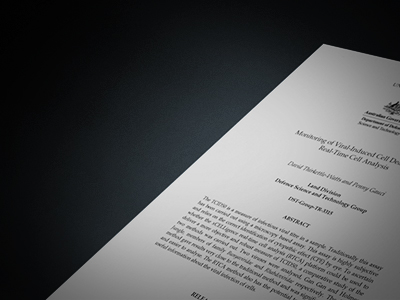
Our scientific output includes report literature
Our scientific and technical publications are an important vehicle for the dissemination of our work.
We have several goals for our publications:
- To communicate the results of the research program to clients and fulfil our reporting responsibilities to the Department of Defence.
- To record the results of our research program.
- To communicate the results of scientific research and technical information to Australian industry and academia.
- To increase awareness of and enhance the reputation of DST Group.
For enquiries about science and technical publications, or to request a publication please contact qfgt.erfrnepu.choyvpngvbaf@qrsrapr.tbi.nh
Latest scientific publications
Technical report
Recent developments in artificial intelligence (AI) have highlighted the significant potential of the technology to increase Defence capability including improving performance, removing humans from high-threat environments, reducing capability costs and achieving asymmetric advantage. However, significant work is required to ensure that introducing the technology does not result in adverse outcomes
Technical report
Anomaly detection is the task of sorting data points into normal and anomalous classes. In a semi-supervised setting, there is only access to normal class samples during the training phase. Through generating and ranking an appropriate scalar quantity, these training samples can be used to calibrate the anomaly detector so that it produces a specified false alarm rate.
Technical note
The patrol boat scheduling problem with complete coverage (PBSPCC) is concerned with scheduling a minimum size fleet of resource-constrained vessels to provide ongoing continuous coverage over a set of maritime patrol regions. The problem is complicated by the necessity for patrol vessels to visit replenishment stations (ports) on a regular basis for mandatory resource replenishment. This problem, which is applicable to maritime border protection and surveillance operations, has its origins in fleet sizing questions raised by the Royal Australian Navy (RAN) and has been a subject of interest for the authors since 2008.
General document
The Defence problem space has expanded considerably in recent years, with the operating environment now ranging from cooperation through to conflict, often with blurred boundaries in between. Additionally, the physical domains of air, land and sea have been expanded to include information and cyber and space. Defence seeks new sources of adversarial advantage to prevail in this contested environment. New operations analysis approaches are required to provide meaningful evidence-based decision-support associated with this problem space.
Technical report
In this report, a power series formulation of feature importance that explicitly identifies individual and interaction-type contributions is discussed.
Technical report
This paper is intended to contribute to both the dialogue around the use of AI in the ADF, as well as to provide a useful resource for ADF members to enhance their education and understanding about the technologies of artificial intelligence, with a particular focus on deep learning.
General document
Defence Science and Technology (DST) Group's Land Capability Analysis (LCA) Future Technology Concept Exploration (FTCE) programme focusses on designing new and novel ways for Army to exploit and counter emerging technologies, and assessing the potential operational effectiveness of the conceptual and structural transformations.
General document
The Defence Science and Technology (DST) Land Capability Analysis (LCA) Future Technology Concept Exploration (FTCE) programme focusses on designing novel ways of operating to exploit and counter emerging technologies, and assessing the potential operational effectiveness of the conceptual and structural transformations.
S&T summary report
The Defence Science and Technology (DST) Group Transonic Wind Tunnel (TWT) in Melbourne was built in the late 1990s and commissioned in 2000. This facility has since been used in a variety of experimental aerodynamic test campaigns to support the Australian Defence Force (ADF), particularly associated with stores clearance and aerodynamic investigations of military aircraft and missiles.